Colorado
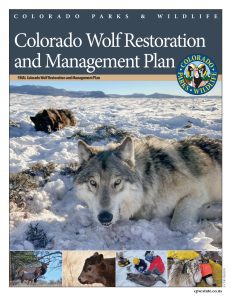 The passage of Ballot Initiative 114 in 2020 forced Colorado Parks and Wildlife to reintroduce the gray wolf into the state. Between the time this initiative made the ballot, and actual election day in November, wolves that were NOT part of the reintroduction effort were reported and confirmed near the Wyoming border. Nevertheless, 10 Wolves were relocated from Oregon and released in Colorado in December of 2023. The current plan authorizes a downlisting of wolves from State Endangered to State Threatened when a minimum wintertime count of 50 wolves anywhere in the state for four successive years. It also authorizes a delisting from the State Threatened and Endangered Species list all together, and a reclassification to a NON-GAME species when a minimum count of at least 150 wolves anywhere in Colorado is observed for two successive years, or a minimum count of at least 200 wolves anywhere in Colorado is observed with no temporal requirement. The current population of wolves is managed by Colorado Parks and Wildlife in partnership with the U.S. Fish and Wildlife Service and considered an “experimental” population under the 10(j) rule.
Utah
 A small portion of northern Utah falls within the federally delisted Northen Rocky Mountain DPS. In 2010, the Utah Legislature directed the Utah Division of Wildlife Resources to prevent any packs of wolves from establishing within the delisted portion of Utah. The law also directed the DWR to request that the U.S. Fish and Wildlife Service immediately remove any wolves discovered in areas of Utah where they are still listed under the Endangered Species Act. The DWR has urged USFW to delist wolves statewide. Currently, there are no known established packs in Utah, though there are many confirmed wolf sightings each year.