Nothing stirs debate these days like predators. Whether it’s the recent ballot initiative in Colorado to end cougar hunting or the downstream ramifications of a similar ballot initiative almost 30 years ago in Washington state, the battle over management decisions and the use of “best available” and “social” science has split a chasm through the wildlife departments and game commissions of many states.
Wildlife for All, Washington Wildlife First and other groups have banged the “social sciences” drum – one that is anything but scientific – in their desire to end predator hunting. In expounding on the virtues of “inclusion” and leaving wildlife management to the pure opinion of “all” – largely uniformed urban and suburban voters – these groups laud the “intrinsic” value of wildlife and lament its loss in any form and for any reason.
The policies they push to limit or eliminate the management of large predators, such as wolves, bears and lions, always contain caveats for public safety and research. As a wildlife biologist who specializes in cougar research and participates in depredation removals, I can tell you these exceptions to killing predators are simply a means to make the policy palatable to voters and do nothing to advance proper management, research or protect the public.
Bad policy propagates poor outcomes while complicating research and setting depredation decisions up for increased conflict at the commission level and in the public square – places where anti-hunting organizations have leverage and palatable messaging. We’ve seen this ad nauseum in Washington state for years now.

Under Washington state law, which was largely shaped in 1996 by Initiative 655 that banned the use of hounds for cougar and bear hunting, we’ve seen oscillating proposals of policy and legislation concerning management decisions in the legislature, commission and by the governor – decisions that should be in the hands of biologists but are now made by politicians.
This bad ballot box decision made almost 30 years ago has arguably led to increased conflicts between cougars and humans, as well as at various levels of government, as citizens try to hammer out how to successfully coexist with apex predators capable of killing large livestock, pets and even humans. County commissioners and sheriff departments in rural areas that have seen depredation and public safety issues explode over the years have taken a very liberal interpretation of the law and have used their authority to quickly kill cougars that might pose a threat to public safety. In turn, groups seeking carte blanche protections for predators use these and other instances of depredation removals to further restrict the authority of who can make these decisions, when and under what circumstances at the commission and legislative level.
Forgetting for a moment the heated politics and pitched battles playing out between governors, legislatures and game commissions behind closed doors and in the media, I’d like to take a look at some of the scientific claims – social and analytical – made by those seeking protections for predators at all costs. We can do this simply by embracing the call for the use of “social science” in decision making and comparing two very different management strategies and the impacts felt on the ground by hunters, the public and by cougars themselves.
The Social Science Argument
I love cougars. I’ve made a living researching them, and with my hounds I have probably put more up a tree in the last decade than just about anyone. They’re incredible animals that deserve our respect and undeniably have a place on our landscapes and in our ecosystems. We must learn to live alongside them – on that point we all can agree.
The real question is: what is the acceptable number of cougars on a landscape?
Honestly, I don’t know the right answer to that question, but I do know the wrong answer – it’s not “more, more, more lions!”
By simply reducing the argument to “more,” we eliminate humans from the wildlife management schema. How we interact (both negatively and positively) with cougars will determine how cougars themselves fare, and whether their populations, including age and sex structures, fluctuate within healthy or unhealthy parameters.
When multimillion-dollar organizations or individuals try to leverage “social sciences” and the will of “all” to end predator hunting, they’re usually advocating for “more, more, more” of the species. Putting aside the nebulousness of social sciences, a logical approach to the question would include both sides of the equation.
I value wild, healthy, organic meat. I value the traditions of hunting for my food. Those who invoke social science to end predator hunting conveniently ignore the impact on those of us who hunt for our food.
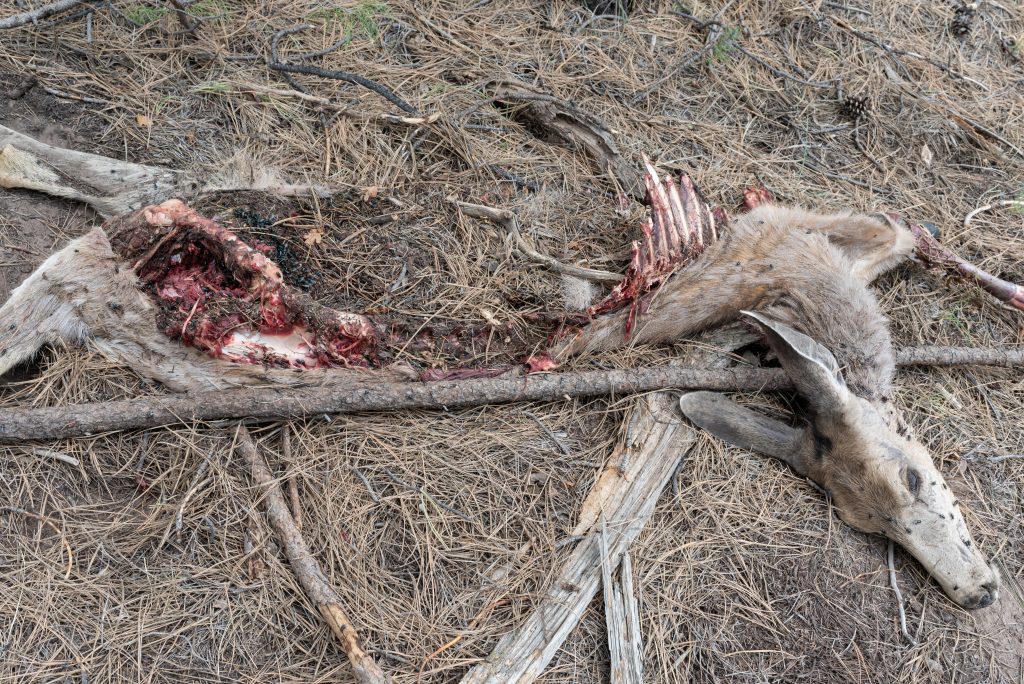
Using some “back of napkin biology,” many states enjoy around a 25% deer hunter success rate, and they protect populations by focusing on harvesting bucks in most circumstances. One cougar kills approximately one deer-sized animal per week – that’s published and established data. Obviously, a predator trying to survive doesn’t show a preference for buck, doe or fawn, it’s an opportunistic killing. To deer herds, every cougar is the equivalent of 200 licensed hunters – more if you extrapolate for does.
When social science is cited, there should be a consideration for deer hunters when we’re talking about cougar management. Not just the financial impact that tag sales bring into a state – $4.2 million in Washington in 2023 – but the truly “socially responsible” question of: “should we feed one lion for a year, or should we feed 50 families?”
This social dilemma is real and includes more than just negative impacts to deer herds and falling success rates for hunters feeding their families, but extends to the convenient crutch anti-hunters use to pass bad policy – that being public safety.
A Tale of Two States
Washington state and Idaho couldn’t be more different. Socially, politically, in almost every way, the two states are completely opposite. But where they do align, literally and figuratively, is along their shared border. The panhandle of northern Idaho abuts eastern Washington, the two states splitting custody of the Selkirk Mountains to the north and varying ecosystems south to the Oregon border. The entirety of Washington’s eastern-most border is shared by Idaho and offers a stark look at the impact of cougar management decisions on their respective citizens.

Unlike Washington, Idaho voters have routinely rejected the interference of out-of-state special interest groups in their wildlife management. In 1996, the same year Humane Society of the United States passed I-655 in Washington, they tried to pass Initiative 2 in Idaho, which would have banned the use of bait and hounds for black bears – it failed by almost 60 percent. Again, the two states are polar opposites when it comes to wildlife. Whether it’s black bears or cougars, Idaho has been a stalwart for hunters while Washington has folded on almost every front – and the results are easy to see.
In Idaho’s Unit 1, where hound handlers routinely run cougars with dogs for training purposes and for hunting, 26 cougars were killed by hunters in 2023 with 17 of them being toms. During that same year, directly across the border in Washington, in an equivalent-sized, adjacent area, 38 cougars were killed and nearly half were females. Further, 17 of those were depredation removals conducted by myself or other state-sanctioned hound handlers. In that same unit, Idaho hunters enjoyed a nearly 50% success rate during deer season, while in Washington deer-hunting success topped out at around 14%.
That stark difference translates to real-world impacts on humans and wildlife alike, including cougar populations and dynamics, and illustrates just one component of how those espousing “more, more, more” in the name of “social science” are doing so without regard for anyone except those promoting their own values. The management decisions in Washington translate to lost opportunities for people, a loss of food for families (both meat from a legally hunted cougar and lower success during deer season) and potential lost revenue for the state as hunters stop buying tags due to those extremely low success rates.
But that’s not the end of the story. The exceptions to predator-hunting bans written into bad policy and law by anti-hunters – that being public safety – can also be clearly illustrated by the imaginary line dividing the two states. Washington is rife with human-cougar conflict. I’ve been to hundreds of cougar depredation calls involving livestock, pets and, yes, even people. It’s not as “rare” of an occurrence as the media would lead you to believe, it’s just not reported unless it’s an extreme example involving the disfigurement or death of a human.

In Idaho, however, it’s completely different. We almost never have a depredation call. Why? One big reason is because cougars are routinely chased by recreational hound hunters. The occasional mature tom might be killed but for the most part, a houndsman’s dogs get worked, the cougar is treed, pictures are taken, and the cat is left unscathed but having learned to avoid humans.
In my research, I collared and studied over 40 cougars’ responses to aversive conditioning with the use of hounds. We approached collared cougars with a speaker playing a human voice at 80dB, about normal for an “outside voice,” and measured their reaction to that stimuli every week while being pursued with hounds. Cougars that were chased with hounds showed a significant increase in their reaction to aversive conditioning while those that were approached and left “unhazed” learned pretty quickly that people in close proximity didn’t lead to any immediate discomfort. There were times that we were able to approach to within 10 meters without the cougar fleeing – it remained hidden, surely watching our approach. For safety’s sake, we backed out of those situations. Habituation like that could very well lead to a cougar making dangerous decisions around people, as we’ve seen with multiple attacks (including fatalities) on popular mountain-biking trails, public parks and a children’s summer camp.
Obviously, variables exist, and rarely in nature can direct comparisons be made, but how Washington and Idaho manage cougars and the absolute difference in the impacts to hunters, prey species, human-wildlife conflict and cougar population dynamics and behavior underscores the importance of management decisions and outcomes. We can’t just leave cougars unmanaged, especially when a vocal minority is screaming “more, more, more,” without weighing the cost to hunters and those who live in cougar country.
How the Sportsmen’s Alliance Fights for Predator Hunters
Nationwide, we’ve fought for and defended bear, lion, coyote and wolf hunters when corrupt commissions and anti-hunters have attempted to upend proven management practices.
 The Sportsmen’s Alliance fights for hunters and proper predator management throughout the West in Arizona, Colorado, California, Oregon and Washington, and in the East in New Hampshire, Vermont, New York, Maine and other states. We’ve filed lawsuits against biased game commissioners in Colorado and petitioned the governor for the removal of commissioners in Washington, and commented on policy changes from a legal perspective with an eye towards the future if litigation is an option to stop the undermining of predator controls. We’ve laid this legal foundation for Washington state’s “Conservation Policy” to the BIDEH Rule coming out of Washington, D.C. Predator hunting has been under attack for years as a way to destroy our entire lifestyle – the Sportsmen’s Alliance will continue to fight for all hunters in the face of this attack.
Like What You Read?

This article originally appeared in Sportsmen’s Alliance members-only magazine. Join the Sportsmen’s Alliance today and be the first to read articles like this with a subscription to The Sportsmen’s Advocate, The Official Publication of the Sportsmen’s Alliance.
More from the Sportsmen’s Alliance
The Sportsmen’s Alliance guarantees hunting, fishing and trapping for the American sportsman now and forever. We’re there when sportsmen need us most. We are the only organization specifically created to protect the individual hunter, angler and trapper – no matter the threat. We will never compromise when it comes to defending our way of life in the courts, in the legislatures, in the public square and at the ballot box. We make this promise to the American sportsman: we will never give up and never give in while proudly securing our future against those seeking to destroy our values, beliefs, and traditions. Stay connected to Sportsmen’s Alliance: Online, Facebook, Twitter and Instagram.