Law schools around the nation have added animal-rights law to their specialties, and one celebrity has spent $10 million funding the movement
Brian Lynn, Vice President of Marketing and Communications
For more than 40 years, the Sportsmen’s Alliance has fought on behalf of hunters, anglers and trappers nationwide. We defend sportsmen in all 50 state legislatures, at the ballot box and in state and federal court. This legal trinity is the foundation of our democratic process, and each has an important role in that process. But, ultimately, each also has flaws that allow popular opinion to subvert scientific management of wildlife and undermine the entire North American Model of Conservation.
Legislation and ballot initiatives often favor large urban voting blocs. What seems reasonable to city-dwelling voters, doesn’t always work for rural, or even suburban or small-town, citizens. And those urban voters don’t have to live with the consequences and repercussions of their ill-informed vote.

The state and federal court system offers sportsmen a more factual course of action, where arguments rest upon legal procedure and practice. But activist judges can let their biases influence rulings, and one bad ruling can set precedent that undermines not just a case at hand, but similar cases and arguments that follow. A prime example is how rulings in the delisting of the Greater Yellowstone Ecosystem grizzly bear case have paralleled earlier rulings in the delisting of Western Great Lakes wolves.
The animal-rights movement recognizes the weaknesses in each of these legal maneuvers and tailors their message to each. For legislative and ballot initiatives, emotional messaging that plays well in the media and with misinformed and otherwise ignorant masses is the ticket. Historically, in the court system, animal-rights organizations, flush with ill-begotten funding, rest their arguments upon mountains of red tape, dragging cases out for decades in an attempt to bankrupt any opposition.
Now, however, animal-rights activists and organizations look to the future and hope to influence the course of legal rulings by seeding judicial benches with biased judges.
Buying the Bench
For the last two decades, animal-rights activists have been burning both ends of a social-engineering candle. With the rise of click-bait headlines and rampant social media, activists can gin up emotional outrage at will, which influences coverage in the news cycle and spurs legislators to take appeasing, and vote-generating, action.
However, they also know that the riotous approach only goes so far, and is often nullified in a court of law. It seems like a far-fetched plot from a dystopian novel, but activists and organizations have been working diligently to engineer not just popular culture through social media, but are going so far as to attempt to dictate future court proceedings.
Since 2001, Bob Barker, former host of the long-running CBS show The Price is Right, has personally bankrolled endowments at influential law schools across the country. The $1-million endowments specifically fund, and mandate the continued availability and teaching of, animal-rights law.

“The laws are not stringent enough, and unfortunately the laws that we do have are not necessarily enforced. If we can get more and more young lawyers to be aware of this, then if they’re involved in a case that involves animals, they’ll know what to do. If they become judges, that’s wonderful, they’re making decisions. And some of these lawyers are going to become politicians,” Barker told The New York Times in 2004. “The most important thing we can do is to change legislation involving animals, and these young people will be in a position to do exactly that. So if the money I invest in this serves to do that, I think it’s money well spent.”
That’s right, Hollywood veteran with a net worth around $70 million hopes to influence future judicial rulings and legislators by training them in law school in matters of animal rights related to philosophical, tort, contract, family, criminal and constitutional law, among others.
According to Taimie L. Bryant, a professor of law at UCLA, one of the schools receiving an endowment, in The Journal of Legal Education:
“Barker has identified three related objectives for his donations: to mandate the existence of animal rights law classes, thereby making those classes predictably available to law students; to educate students in animal rights law classes and to see them go on to become judges or legislators better able to understand the value and need for more animal protections by enactment of new laws and enforcement of existing laws; and to increase the probability that animal rights law classes would be offered at law schools nationwide.”
Barker has made a conscious effort to influence future proceedings by specifically funding animal-rights tracts at influential and geographically diverse law schools, including Harvard, UCLA, Duke, Columbia, Virginia, Georgetown, Northwestern and Stanford. Additionally, Barker has given $2 million to his alma mater, Drury University in Missouri, for the same purpose for undergraduates.
Funding Extremists
An optimist might argue that Barker is simply advocating for responsible pet ownership and animal welfare, such as spay and neutering of pets, which is what he implored people to do as he signed off at the end of every episode of The Price is Right. Indeed, he spent $25 million creating the DJ&T Foundation, named after his late wife and mother, which subsidizes spay and neutering efforts. But a closer look at other organizations Barker has funded and affiliates with reveals that his interests go far deeper than animal welfare.
Barker donated $2.5 million to the radical group People for the Ethical Treatment of Animals (PETA) to help them establish a West Coast headquarters in Los Angeles, which heads up their media and youth-outreach programs, among other things. He worked closely with the Humane Society of the United States’ legislative effort to end pigeon shoots in Pennsylvania, including donating $1 million to the work.
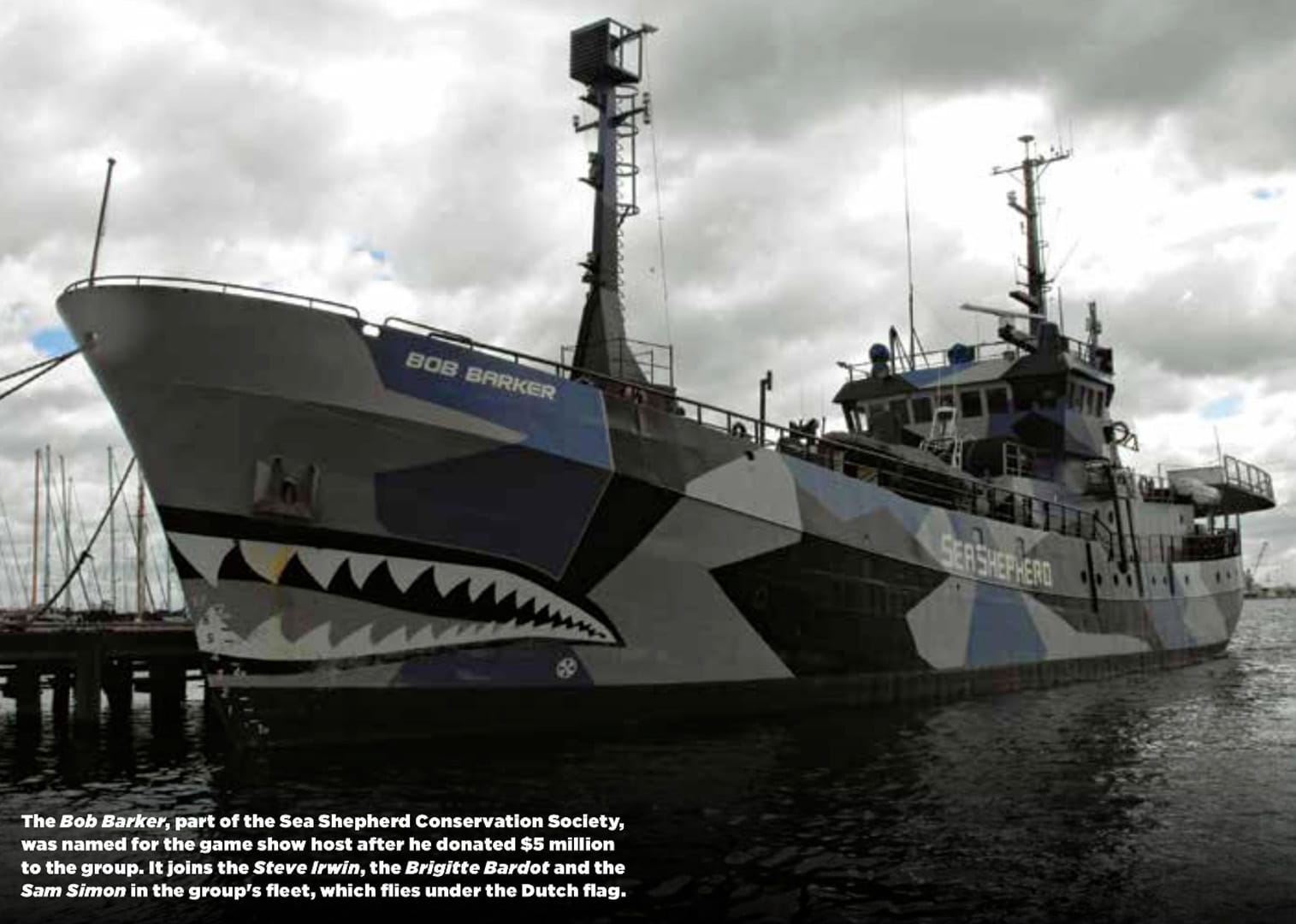
Perhaps most telling, Barker gave $5 million to Sea Shepherd, which was used to outfit an anti-whaling vessel. Sea Shepherd is spearheaded by Paul Watson, who was also a founding member of Greenpeace, but was eventually kicked out of the organization for being too radical. Indeed, Sea Shepherd has been flagged by Interpol, restricted by U.S. courts, has radical environmentalists on its board of directors (as well as Hollywood elites) and has been denounced for dangerous tactics, including ramming and sinking boats at sea, setting mines and engaging in chemical warfare tactics.
The Price was Right: Growth and Impact
Without a doubt, Barker’s money and influence has pushed animal-rights law forward by leaps and bounds. In 2001, before Pearson Television made the first donation of $500,000 to Harvard Law School in Barker’s name (to celebrate his 30 years as host of The Price is Right), only nine schools had offered animal-law classes.
After that initial donation, and the subsequent $9.5 million to other schools, more than 167 law schools in the U.S. and Canada currently offer classes in the discipline, or, as in the case of the schools receiving million-dollar endowments, complete and sustained tracks in animal-rights law. But it doesn’t end there; this is a global movement. Australia and New Zealand have 11 law schools offering animal-rights law, the United Kingdom has seven and Europe has at least four other countries whose law schools offer classes. Even the University of Hong Kong Faculty of Law has gotten in on the action.
If a philanthropist’s goal is to leave an enduring legacy long after they’re gone, then the 96-year-old Barker has by all accounts succeeded. His strategic funding of animal-rights law has left an indelible mark on the movement that will be heard in courtrooms around the world for generations to come. Barker’s money and fame, even in the twilight of his life, has jumped started a dangerous movement that will groom future lawyers to advance the animal-rights agenda, to seed judicial benches with biased and activist judges who will preside over future cases and offer rulings, and to create legally trained allies in state legislatures.
Barker’s $10 Million in Endowments
 The creation of $1 million endowments throughout the country ensures that animal-rights law will continue as a track of study in perpetuity at these prestigious law schools. Beyond mere theory and philosophical training, the tracks have real-world implications.
The Animal Legal Defense Fund (ALDF), an animal-rights organization that files high-impact lawsuits to protect animals from harm, provides free legal assistance and training to prosecutors, supports animal-right legislation, and provides resources and opportunities to law students and professionals to advance the field of animal law, has student chapters in colleges nationwide. The non-profit pulls law students into the animal-right fold and fosters the misguided philosophical and legal ploys of the movement.
Perhaps even more dangerous, schools with Barker-backed endowments have close relationships with not just ALDF, but also the Humane Society of the United States. Georgetown, in particular, has close ties with the animal-rights juggernaut, with HSUS legal counsel giving lectures, leading entire classes and offering internships.
Like What You Read?

This article originally appeared in the 2019 issue of the Sportsmen’s Alliance members-only magazine. Join the Sportsmen’s Alliance today and be the first to read articles like this with a subscription to The Sportsmen’s Advocate, The Official Publication of the Sportsmen’s Alliance.
About the Sportsmen’s Alliance: The Sportsmen’s Alliance and its supporting Foundation protect and defend America’s wildlife conservation programs and the pursuits – hunting, fishing and trapping – that generate the money to pay for them. The organization accomplishes this mission through several distinct programs, including public education, advocacy, litigation and research. Stay connected to the Sportsmen’s Alliance: Online, Facebook, Twitter and Instagram.